

TL;DR

Get health and wellness essentials delivered free with Prime
- Fast, free delivery on millions of items
- Prime Video, Amazon Music and more included
- Member-only deals all year
The Buck Institute and Georgetown University are co-leading a four-year research consortium backed by an ARPA-H award of up to $51.7 million. The team aims to predict how intrinsically disordered proteins behave in different cellular conditions and identify shifts associated with disease, initially studying Alzheimer’s disease and Ewing sarcoma. The work is intended to support future diagnostics and treatments, but it has not yet produced a clinical test or therapy.
The Buck Institute for Research on Aging and Georgetown University are co-leading a four-year research effort funded by an Advanced Research Projects Agency for Health (ARPA-H) award of up to $51.7 million to predict how certain proteins shift toward disease-associated behavior. The consortium, called Team SEEDS, will combine computational models with laboratory experiments, initially focusing on Alzheimer’s disease and Ewing sarcoma.
SEEDS stands for Sequence-to-disease: Environment-aware Ensembles of Disordered proteins at Scale. Georgetown’s Priyanka Joshi and the Buck Institute’s Chuankai (Kai) Zhou co-lead the project. The consortium includes researchers from nine academic institutions and seven industry partners, bringing together expertise in protein science, artificial intelligence, computational modeling, cancer and neuroscience.
The research centers on intrinsically disordered proteins (IDPs), which do not settle into one stable three-dimensional shape. Instead, they can take on many forms, with their behavior influenced by conditions inside cells. The source report identifies acidity, molecular crowding, metals, metabolites and chemical modifications as factors that may affect those forms. Such flexibility is part of how IDPs function in healthy cells, but it also makes their behavior difficult to predict and target when it changes in ways associated with disease.
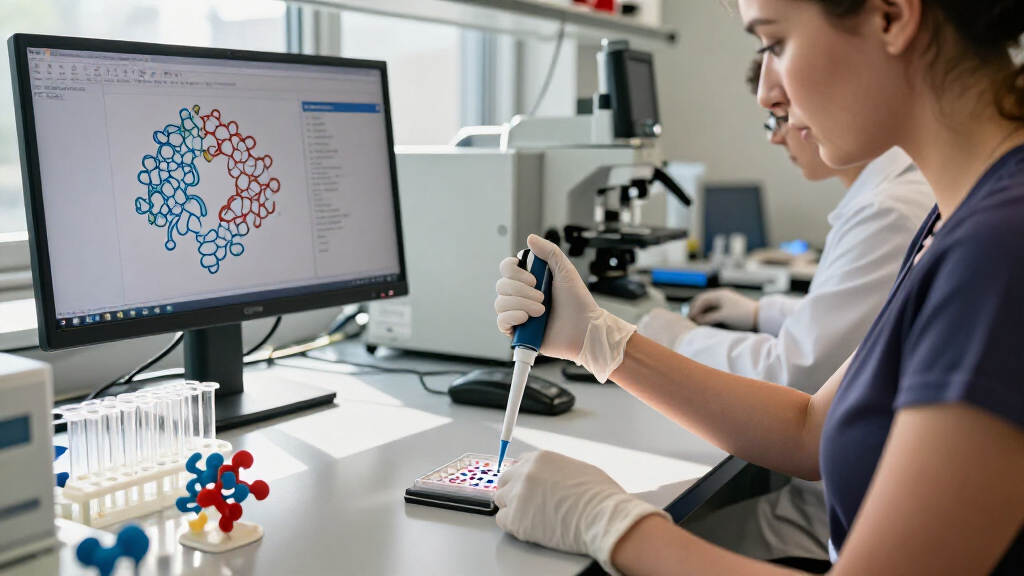
The team plans to map how protein sequence and cellular surroundings relate to protein behavior. It will use physics-guided artificial intelligence alongside experimental measurements, testing predictions in laboratory settings rather than relying on computation alone. The project’s intended applications include detecting, slowing or treating disease, but the award announcement describes research goals—not a validated diagnostic or treatment.
Why Early Protein Shifts Matter
Researchers often study protein misfolding and aggregation after proteins have already changed shape or clumped together. The SEEDS effort instead targets the earlier stages, asking whether changes in a protein’s environment can help predict when it may move away from healthy behavior. If that approach succeeds, it could give researchers a way to investigate disease-associated processes before they lead to lasting cellular damage.
The effort also addresses a challenge in drug development. Many proteins linked to misfolding-related conditions have been described as “undruggable” because they lack the stable shapes and binding pockets that conventional medicines are commonly designed to target. Understanding how these proteins behave across multiple forms and cellular conditions could, in principle, offer new routes to detection or intervention. That possibility remains a research aim, not an established outcome.
The initial focus on Alzheimer’s disease and Ewing sarcoma connects the project to neurological disease and cancer, but the source report does not say that the consortium will deliver patient-ready tools within the four-year award period. Its immediate value will depend on whether the team can produce reliable predictions and confirm them experimentally.
As an affiliate, we earn on qualifying purchases.
From Protein Snapshots to Prediction
Proteins with stable structures can often be studied by examining their shapes, and artificial-intelligence tools such as AlphaFold have advanced protein science by learning from large stores of structural data. The source report says researchers have far less structural information for intrinsically disordered proteins, making it harder to build models that predict how they behave.
Current methods can capture snapshots of these proteins, often after they have already aggregated, but researchers cannot reliably predict from those observations alone how the proteins will respond as cellular conditions change or when a harmful shift begins. SEEDS aims to move beyond studying proteins one at a time by relating their sequences and environments to behavior at scale, while closely examining selected examples through experiments.
The project is part of ARPA-H’s BIOmolecular Grammar for protein Aggregation Modulation and Intervention (BIOGAMI) program, which focuses on early stages of protein dysfunction. BIOGAMI is led by ARPA-H Program Manager Shannon Greene. The program’s “grammar” framing refers to the effort to identify rules linking protein sequence and surroundings to how flexible proteins behave.
“We aim to uncover the principles that determine when these proteins remain in healthy functional ensembles and when they begin to shift toward disease-associated states.”
— Chuankai (Kai) Zhou, assistant professor at the Buck Institute
As an affiliate, we earn on qualifying purchases.
Predictions Still Need Testing
The award announcement does not report results from the SEEDS research or specify a completed predictive model, diagnostic test or treatment. It also does not detail the award’s payment schedule or how much funding the consortium will ultimately receive beyond stating that the award is up to $51.7 million.
It remains to be shown whether models can predict harmful changes accurately across different proteins and changing cellular environments, and whether experimental results will support those predictions. The source report does not provide a detailed timetable for individual studies, clinical trials or patient use. The planned four-year research period should not be read as a promise that a clinical product will be ready by its end.
molecular biology laboratory equipment
As an affiliate, we earn on qualifying purchases.
As an affiliate, we earn on qualifying purchases.
Four Years of Model Testing
During the planned four-year effort, the consortium intends to build and test methods for connecting protein sequences and cellular conditions to protein behavior. Its approach pairs computational predictions with experimental measurements, so researchers can compare model outputs with observed behavior and refine the models as the work proceeds.
The project’s next meaningful milestones will be evidence that the models can make reproducible predictions under different conditions and that experiments support those predictions. The source material does not give dates for those milestones or describe a specific public reporting schedule. The team’s initial research focus is Alzheimer’s disease and Ewing sarcoma; further details about findings, diagnostic development or treatment research remain to come.
As an affiliate, we earn on qualifying purchases.
Key Questions
Who is leading the protein research effort?
The project is co-led by Priyanka Joshi of Georgetown University and Chuankai (Kai) Zhou of the Buck Institute. Its consortium includes researchers from nine academic institutions and seven industry partners.
How much funding did the team receive?
ARPA-H awarded the effort up to $51.7 million. The source report does not specify how much of that maximum will be paid or provide a funding schedule.
What proteins will the researchers study?
The team is studying intrinsically disordered proteins, which can take on multiple shapes rather than maintaining one stable structure. The initial disease focus is Alzheimer’s disease and Ewing sarcoma.
Does the award mean a new diagnostic or treatment is available?
No. The award supports research intended to improve prediction of protein behavior and potentially inform future diagnostics or treatments. The source report does not announce a validated test, approved treatment or clinical results.
How will the team check its predictions?
SEEDS plans to pair computational modeling, including physics-guided AI, with experimental measurements. Researchers will test protein behavior under different conditions rather than relying on computer predictions alone.
Source: rss
Halloween Picks
halloween
As an affiliate, we earn on qualifying purchases.