
By optimizing fermentation processes and using renewable feedstocks like agricultural waste and algae, you can substantially reduce land and water consumption. Fine-tuning parameters such as temperature and pH improves efficiency, while circular economy practices turn waste into resources. These innovations lower resource needs, cut greenhouse gases, and support sustainability. If you want to explore how these strategies work together to create eco-friendly solutions, you’ll find more insights ahead.
Key Takeaways
- Optimizing bioreactor parameters enhances efficiency, increasing yields while minimizing land and water requirements.
- Using renewable feedstocks like agricultural waste reduces reliance on resource-intensive inputs and lowers environmental impact.
- Integrating process innovations such as water recycling and high-concentration fermentation lessens resource consumption.
- Combining bioreactor optimization with renewable feedstocks promotes sustainable production and decreases greenhouse gas emissions.
- These strategies collectively preserve land and water resources, supporting eco-friendly, circular bioeconomy development.
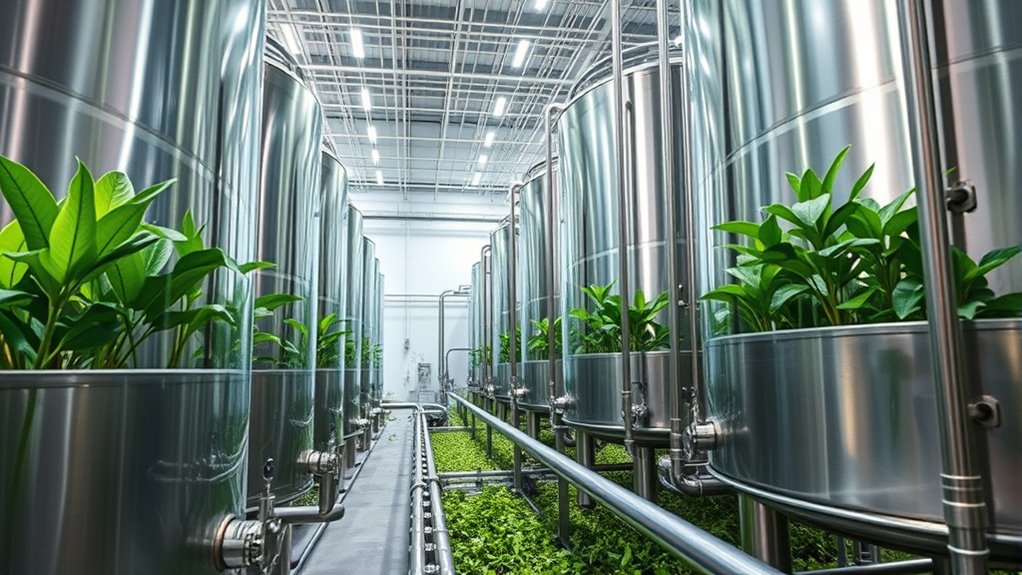
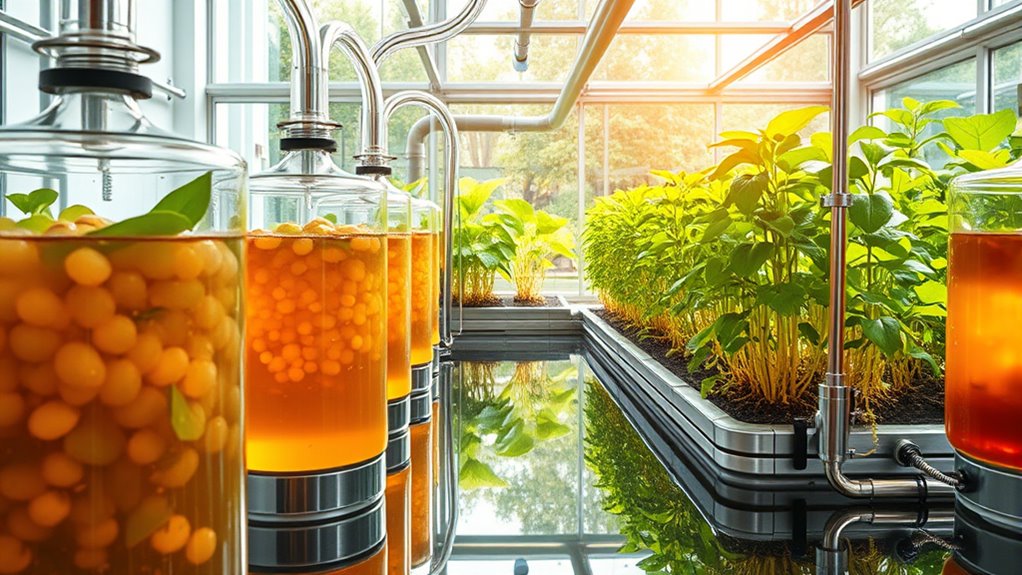
Have you ever wondered how fermentation technology can contribute to a more sustainable future? It’s a powerful tool that can considerably reduce land and water use, especially when you focus on bioreactor optimization and renewable feedstocks. By carefully designing and controlling fermentation processes, you can maximize productivity while minimizing resource consumption. Bioreactor optimization plays an essential role here. When you fine-tune parameters like temperature, pH, oxygen levels, and agitation, you create an environment where microorganisms thrive efficiently. This not only boosts yields but also reduces the need for large-scale land areas and water inputs. The more you optimize, the less raw material and water are required to produce the same amount of bioproducts, making the process more sustainable.
Optimizing bioreactors enhances sustainability by increasing yields and reducing land and water resource use.
Switching to renewable feedstocks is another critical aspect. Instead of relying on traditional, resource-intensive inputs like fossil fuels or extensive agricultural crops, you can utilize renewable resources such as agricultural waste, algae, or other biomass. These feedstocks are often abundant and can be sourced locally, which cuts down transportation emissions and reduces pressure on land and water resources. Using renewable feedstocks also aligns with circular economy principles, where waste becomes a valuable input. For example, converting crop residues into fermentable sugars reduces the need to grow dedicated crops solely for industrial purposes, saving land and water that would otherwise be dedicated to agriculture.
When you integrate these strategies, fermentation technology becomes a cornerstone for sustainable production. You can produce a range of biochemicals, biofuels, and materials without overburdening ecosystems. As you optimize bioreactors, you can operate at higher efficiencies with less water and land. Choosing renewable feedstocks ensures that you’re not depleting finite resources and are instead harnessing renewable ones, which regenerate naturally. This approach helps reduce greenhouse gas emissions, preserves biodiversity, and conserves water resources—all necessary for a sustainable future.
Moreover, incorporating innovations like closed-loop systems and process intensification further enhances resource efficiency. These advancements allow you to recycle water within the process and operate at higher concentrations, decreasing the overall footprint. Additionally, adopting sustainable manufacturing practices can further reduce environmental impact and resource use. As you adopt these practices, you’ll find that fermentation technology not only meets industrial needs but does so in harmony with environmental limits. It’s a practical, scalable way to produce essentials while safeguarding our planet’s land and water for future generations.

Bioreactor System Design (Biotechnology and Bioprocessing)
As an affiliate, we earn on qualifying purchases.
As an affiliate, we earn on qualifying purchases.
Frequently Asked Questions
How Does Fermentation Technology Impact Biodiversity Conservation?
You can see how fermentation technology supports biodiversity preservation by reducing the need for large land areas and water resources, which helps protect ecosystems and wildlife habitats. By producing essential materials more efficiently, you help maintain ecosystem health and prevent habitat destruction. This approach minimizes environmental stress, allowing natural biodiversity to thrive while meeting industrial demands, making it a sustainable solution that benefits both human needs and the planet’s ecological balance.
Are There Any Economic Incentives for Adopting Sustainable Fermentation Practices?
Yes, adopting sustainable fermentation practices can offer you significant economic incentives. You might receive government economic subsidies or benefit from market incentives like consumer preferences for eco-friendly products. These incentives encourage you to implement greener methods, reduce costs, and improve your brand reputation. By aligning your practices with sustainability goals, you can access financial support and tap into growing markets that value environmentally responsible production.
What Are the Challenges in Scaling up Sustainable Fermentation Processes?
You face challenges in scaling up sustainable fermentation processes, mainly due to high initial costs of implementing cost-effective methods and steering regulatory hurdles. These hurdles can slow progress, requiring thorough testing and compliance efforts. Additionally, maintaining consistent quality and optimizing resource use at larger scales are complex tasks. Overcoming these obstacles demands strategic planning, investment, and collaboration to guarantee sustainable practices are feasible and beneficial at industrial levels.
How Does Fermentation Technology Affect Greenhouse Gas Emissions?
While fermentation technology gently steers us toward a greener future, it can influence greenhouse gas emissions through biogas production. By optimizing microbial efficiency, you can minimize methane release, a potent greenhouse gas. This process helps you reduce your carbon footprint, making your efforts more sustainable. Embracing these innovations allows you to transform waste into valuable energy, ensuring a healthier planet for generations to come.
Can Fermentation Reduce Reliance on Traditional Agriculture?
Yes, fermentation can reduce your reliance on traditional agriculture by providing synthetic nutrients that support urban farming. This technology allows you to produce food closer to where people live, saving land and water. Instead of relying solely on conventional farming, you can use fermentation to generate sustainable, nutrient-rich solutions, making urban farming more efficient. This approach helps you cut down on resource use and promotes local food production.
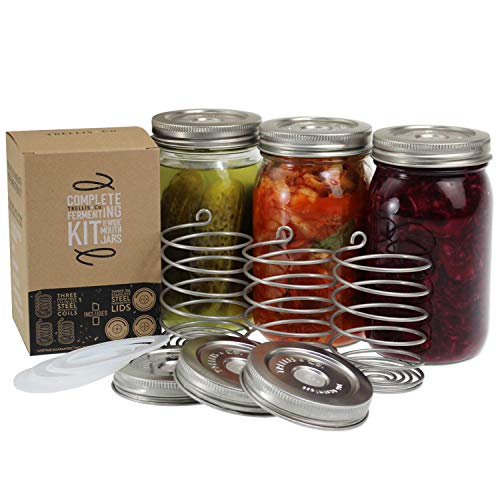
Trellis + Co. Stainless Steel Fermentation Jar Kit | 3 Waterless Fermenter Airlock Lids & 3 Pickle Helix Fermentation Weights, for Wide Mouth Mason Jars | Recipe eBook Included with Fermenting Kit
KIT INCLUDES: 3 x 316 Stainless Steel Fermentation Lids with waterless silicone airlocks for wide mouth canning jars….
As an affiliate, we earn on qualifying purchases.
As an affiliate, we earn on qualifying purchases.
Conclusion
By embracing fermentation technology, you can considerably reduce land and water use, making sustainability achievable. This innovative approach shows that necessity truly is the mother of invention, proving that smart solutions can lead to a greener future. As you adopt these methods, remember that small changes add up—every step counts in protecting our planet. Staying committed to sustainable practices ensures a healthier Earth for generations to come, because sometimes, less truly is more.

FastRack 5 Gallon Hedpak with Cap | BPA-free, Food-Grade, and Leak-Proof | White Water Container | Ideal for brewing, fermentation, or storage
[What’s Included?] With this purchase, you'll receive one 5-Gallon Hedpack with cap, made with Food-Grade & BPA-Free material…
As an affiliate, we earn on qualifying purchases.
As an affiliate, we earn on qualifying purchases.
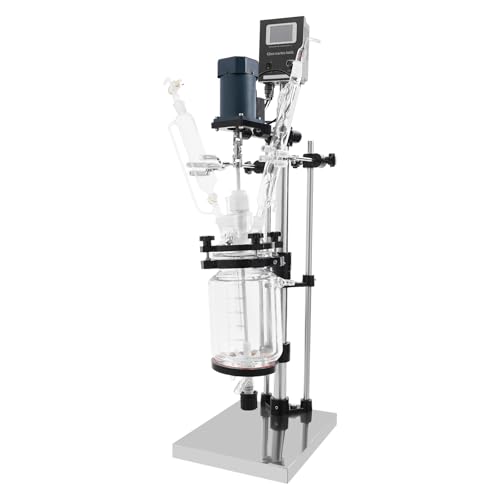
Liffshsy Double-Layer Glass Reactor, 3L Jacketed Glass Reactor Lab Chemical Reaction Vessel Digital High-Efficiency Reflux Condenser 680r/min 90W 110V Adjustable Temperature Heating Mixing Reactor
【Made to Last】: Made of high-class high borosilicate glass and stainless steel, this product is sturdy and not…
As an affiliate, we earn on qualifying purchases.
As an affiliate, we earn on qualifying purchases.