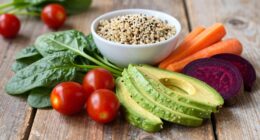


To calculate your salad’s carbon cost, start by estimating the distance each ingredient travels from farm to table. For example, if your lettuce is shipped from California to your home, it has a higher food mile count compared to produce sourced locally. Next, consider the transportation mode—trucks, ships, or planes—as each impacts emissions differently. Understanding these factors helps you see how far your food travels and its environmental impact, and you’ll discover simple ways to make smarter, greener choices.
Key Takeaways
- Determine the origin of each ingredient in your salad to assess transportation distances.
- Calculate the total miles traveled by each component from farm to plate.
- Identify transportation modes (truck, ship, plane) and their respective emissions per mile.
- Use emission factors (e.g., CO2 per ton-mile) to estimate the carbon footprint of each ingredient.
- Sum all emissions to find the overall carbon cost of your salad, emphasizing local sourcing to reduce it.

When you buy food, you might not realize how far it has traveled to reach your table. Every apple, lettuce, or tomato has a journey behind it, often spanning hundreds or even thousands of miles. This distance, known as food miles, directly impacts the environment through transport emissions. The longer the journey, the more fuel is burned, releasing greenhouse gases into the atmosphere. Transport emissions are a major contributor to the carbon footprint of your food, especially when produce is shipped across countries or continents. That’s why contemplating local sourcing can make a big difference. When you choose foods grown nearby, you considerably cut down on the travel distance, reducing transport emissions and lowering your overall food’s carbon cost. **Understanding the concept of carbon footprint can help you make more sustainable choices**. Calculating your salad’s carbon cost starts with understanding where each ingredient comes from. For example, if your lettuce was shipped from California to your grocery store in New York, it likely traveled over 2,500 miles. By contrast, if you buy lettuce from a local farm just a few miles away, the transport emissions are minimal. To estimate the carbon footprint, you need to consider the type of transportation used—truck, ship, plane—and the amount of fuel consumed per mile. Trucks, which are common for delivering produce to stores, emit a substantial amount of CO2 per ton-mile, making local sourcing a more sustainable choice. Shipping by plane, although faster, produces even higher emissions, so it’s best to avoid highly air-freighted foods when possible. Tracking food miles also involves understanding how your food is transported and how efficiently it’s moved. For instance, produce shipped in bulk via cargo ships tends to have a lower carbon footprint per unit than small-scale air freight. When you opt for local sourcing, you’re not only reducing transport emissions but also supporting local farmers and communities. This often means fresher produce, fewer preservatives, and less packaging, all of which contribute to a smaller environmental impact.

Etekcity Smart Food Kitchen Scale with Nutritional Calculator, Free App with 19 Nutrients Tracking, Calorie, Marco, Digital grams and ounces for weight loss, Premium Stainless Steel, 11lb
𝗬𝗼𝘂𝗿 𝗛𝗲𝗮𝗹𝘁𝗵 𝗘𝘅𝗽𝗲𝗿𝘁: Easily track your intake of up to 19 nutrients, monitor trends, create daily, weekly and…
As an affiliate, we earn on qualifying purchases.
As an affiliate, we earn on qualifying purchases.
Frequently Asked Questions
How Do Food Miles Affect Overall Environmental Sustainability?
You might not realize it, but food miles directly impact environmental sustainability. When your food travels long distances, it increases emissions and resource use, harming the planet. Supporting local, farm-to-table movement and choosing sustainable packaging can reduce your carbon footprint. By being mindful of food miles, you promote eco-friendly practices and help create a more sustainable future, making your choices more impactful for the environment.
Can Reducing Food Miles Significantly Lower My Carbon Footprint?
Think of your carbon footprint as a garden—you can’t ignore the weeds. Reducing food miles is like pulling those weeds, making your garden healthier. Cutting back on food transport, especially for fresh produce, can appreciably lower your emissions. Look for carbon labeling on products to choose local options. While it’s not the only step, lowering food miles makes a real difference in shrinking your overall environmental impact.
Are Local Foods Always More Eco-Friendly Than Imported Ones?
You might think local foods are always greener, but that’s not always true. Seasonal eating and urban farming can make local options more eco-friendly, reducing transportation and supporting sustainable practices. However, imported foods grown in ideal conditions might sometimes have a lower carbon footprint. So, consider how food is grown, when it’s in season, and local farming methods to truly assess eco-friendliness, rather than just origin.
What Are the Best Ways to Track Food Miles for My Groceries?
You can track food miles by using dedicated tracking apps that calculate the distance your groceries travel from farm to table. Add items to your shopping list, then input their origins to get a clear picture of their carbon footprint. Some apps even scan barcodes for quick data entry. By monitoring this info regularly, you make more eco-friendly choices and reduce your overall carbon impact when shopping.
How Do Transportation Methods Influence the Carbon Cost of Food?
Transportation methods directly impact the carbon cost of your food by affecting transportation emissions and delivery efficiency. When you choose air freight, it increases emissions markedly compared to sea or rail transport. Opting for local or faster delivery methods can also raise the carbon footprint. To reduce your food’s environmental impact, prioritize transportation options that maximize delivery efficiency and lower transportation emissions, such as bulk shipping or local sourcing.
Reusable Cotton Mesh Produce Bags – 100% Organic Cotton, Durable, Double Stitched, Washable with Tare Weight & Drawstring – Mesh Bags for Grocery Shopping, Vegetables & Fruits | Set of 6 (2L, 2M, 2S)
🌱 REUSABLE PRODUCE BAGS TO PROTECT THE PLANET – With these reusable produce bags, you can do your…
As an affiliate, we earn on qualifying purchases.
As an affiliate, we earn on qualifying purchases.
Conclusion
Now that you know how to calculate your salad’s food miles, imagine what revealing the true carbon cost could mean for your choices. Will you keep sourcing locally or continue supporting long-distance transportation? The impact of your decision might surprise you—and not just on your plate. Stay tuned, because understanding these hidden miles could change the way you see every meal. Are you ready to uncover the secret behind your food’s journey?
Glass Food Storage Containers with Bamboo Lids (4 Pack, 36 Ounce) Eco Friendly Meal Prep Containers Airtight – Plastic Free, BPA Free
✅ MEETS YOUR STORAGE NEEDS – Made of borosilicate, the strongest glass available, our kitchen ware can withstand…
As an affiliate, we earn on qualifying purchases.
As an affiliate, we earn on qualifying purchases.

Dishing Up the Dirt: Simple Recipes for Cooking Through the Seasons (Farm-to-Table Cookbooks, 1)
As an affiliate, we earn on qualifying purchases.
As an affiliate, we earn on qualifying purchases.