

TL;DR

Get health and wellness essentials delivered free — and shop member deals
- Fast, free delivery on millions of items
- Access to Prime Big Deal Days deals on October 6–7
- Prime Video, Amazon Music and more included
A study of 24 healthy young adults found that a 10-minute session of very slow running was followed by improved mood and Stroop-test performance, alongside increased prefrontal-cortex activity. The results are short-term findings from a small study, not evidence that slow jogging produces lasting mental-health benefits or is suitable for everyone.
A study published in Imaging Neuroscience found that 10 minutes of very slow running was followed by improved mood and better performance on a test of attention and executive function among 24 healthy young adults. The University of Tsukuba researchers also recorded increased activity in parts of the prefrontal cortex, but the small experiment measured immediate effects and does not establish lasting benefits.
Participants completed two separate 10-minute sessions: one sitting on a stationary treadmill and one running at an extremely slow pace. The source report says their running speed was about 3 to 6 kilometers per hour (roughly 1.9 to 3.7 miles per hour), at an intensity of about 35% of peak oxygen uptake. Researchers measured mood, cognitive performance and prefrontal-cortex activity before and after each session, using functional near-infrared spectroscopy to assess brain activity.
After the slow-running session, participants reported a more pleasant mood and performed better on a Stroop test, which assesses aspects of executive function, including attention and the handling of conflicting information. Researchers also observed increased activity in prefrontal-cortex areas associated with executive function and mood regulation. The sitting session did not produce comparable changes, according to the report.
The findings concern changes recorded immediately after exercise. The reported study does not show whether the effects lasted, whether repeated sessions would have similar results, or whether they apply to older people or people with health conditions. The report also does not establish that slow jogging prevents or treats mental-health conditions.
A Short, Lower-Intensity Option
The study offers a possible alternative for people who find conventional running too strenuous or off-putting: a short bout of movement at a pace closer to walking. Its reported results suggest that, in this experiment, participants did not need to run fast or exercise intensely to show immediate changes in mood and test performance. That may be relevant to people seeking a brief activity break, though the findings do not prove that a 10-minute jog improves everyday work or concentration.
The practical distinction is not a claim that slow jogging is better than walking. The report says the researchers set out to examine whether running’s movement pattern might produce effects different from other activity. Walking remains a form of physical activity, and the study did not compare slow jogging directly with a walking session. Readers should treat this as an early research finding, not a reason to replace an activity they already do.
For readers considering a change in exercise, the modest session length may make the idea easier to picture, but physical ability and health needs vary. The study involved healthy young adults in a controlled setting, so it cannot determine what pace or activity is appropriate for an individual. People with questions about exercise and a health condition can seek guidance from a qualified health professional.
As an affiliate, we earn on qualifying purchases.
What Researchers Mean by Slow Jogging
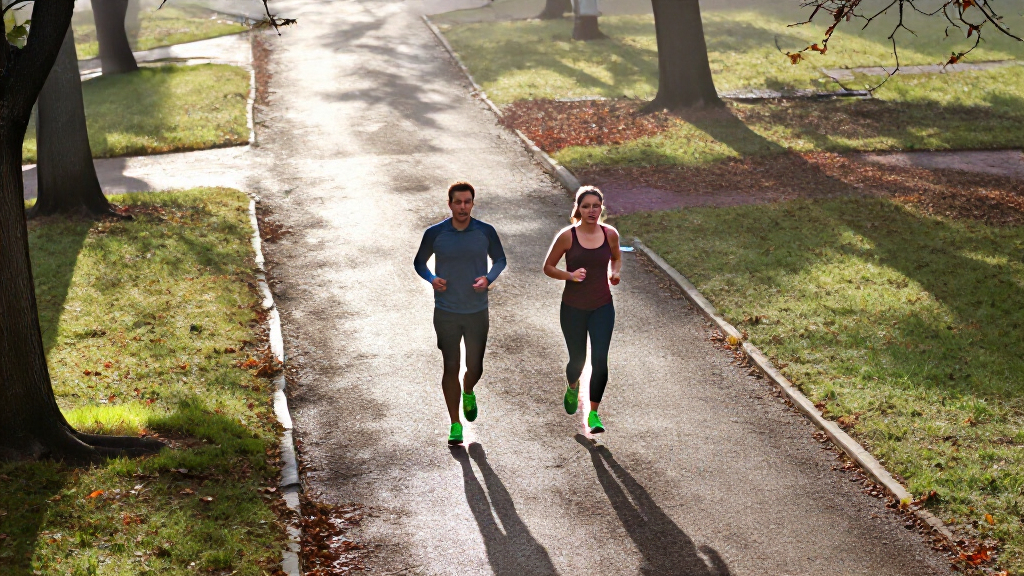
The source report describes slow jogging as running at a comfortable, conversational pace—slowly enough for a person to talk without gasping. The approach is associated with Japanese exercise physiologist Hiroaki Tanaka and the term niko niko pace, translated in the report as “smiling pace.” At these speeds, a brisk walker may move faster, but the movement differs: in running, both feet briefly leave the ground, while walking keeps at least one foot in contact with it.
The researchers were interested in the mechanics of that movement, including the rhythmic up-and-down motion of the body and head. Sensors measured head acceleration during the sessions. The report says participants with greater vertical head movement tended to show larger mood improvements, but this was an association within the study, not proof that the movement caused the change.
The report also cites earlier animal research suggesting that head acceleration could affect neurons involved with serotonin, a neurotransmitter connected with mood. That explanation remains theoretical in humans. It should not be treated as a confirmed account of why participants’ mood changed.
“Soya suggested that a brief, slow run might help before a presentation or another mentally demanding task.”
— Hideaki Soya, study supervisor, as described by Seniors Guide
As an affiliate, we earn on qualifying purchases.
Limits of the Short Experiment
The source report describes a study of 24 healthy young adults and two short sessions. It does not provide enough information here to assess how representative the participants were or whether the findings would hold in a larger, more varied group. The reported outcomes were measured directly after exercise, so the duration of any mood or cognitive changes is unknown.
It is also unclear whether slow jogging itself, rather than another difference between the two sessions, explains the results. The experiment compared running with sitting, not with walking or another form of exercise. Researchers recorded an association between head movement and mood change, but the proposed explanation involving brain signaling has not been established in humans. The source material does not state whether further study has begun or provide a timetable for follow-up research.
functional near-infrared spectroscopy device
As an affiliate, we earn on qualifying purchases.
As an affiliate, we earn on qualifying purchases.
Further Research on Movement and Mood
The researchers’ next task is to test whether the observed changes can be repeated and to clarify what role running mechanics may play. The source report says they plan to investigate the link between vertical head movement and mood further; it does not specify a study schedule or describe a confirmed follow-up trial.
For now, the finding is best read as an initial, short-term result from a small group, rather than a general prescription. Further research would need to establish whether effects persist, how slow running compares with walking, and whether results extend to people of different ages and health backgrounds.
As an affiliate, we earn on qualifying purchases.
Key Questions
What did the slow-jogging study find?
In 24 healthy young adults, a 10-minute very slow run was followed by a more pleasant mood, improved Stroop-test performance and increased activity in some prefrontal-cortex areas. The study measured immediate changes after exercise.
How fast did participants run?
The source report gives a pace of about 3 to 6 kilometers per hour, or roughly 1.9 to 3.7 miles per hour. It describes the activity as very light and conversational.
Does the study show that slow jogging is better than walking?
No. The reported experiment compared slow running with sitting, not with walking. The report does not suggest that people should stop walking or replace it with jogging.
Do the findings prove that slow jogging improves mental health over time?
No. The study reported immediate mood and test-performance changes after one short session. It did not establish long-term effects or show that slow jogging treats or prevents a mental-health condition.
Why might running affect mood differently from walking?
Researchers explored whether running’s rhythmic up-and-down movement could be relevant. Participants with greater head movement tended to show larger mood improvements, but the reason is unknown and the proposed brain mechanism remains theoretical in humans.
Source: rss
Cold & flu season Picks
humidifiers
As an affiliate, we earn on qualifying purchases.