
Most vitamin D3 supplements come from lanolin, a sheep-derived wax, which makes finding a genuinely vegan option trickier than it sounds. The products in this roundup instead use lichen-derived D3, the only plant-based source of true cholecalciferol. My top pick overall is the Naturalis Vegan Vitamin D3 + K2 Softgels, which pairs a therapeutic 5,000 IU dose with 120 mcg of MK-7, a combination that supports both bone and cardiovascular health. If you want a simpler approach, Igennus Vegan Vitamin D3 365 Tablets offers a full year of maintenance-dose supply, while Sports Research Vegan D3 + K2 stands out for its coconut-oil base that aids absorption. The main tradeoffs you’ll face are dose (1,000 IU maintenance versus 5,000 IU correction), whether to add K2, and softgel versus tablet formats. Keep reading for the full breakdown.

Get health and wellness essentials delivered free with Prime
- Fast, free delivery on millions of items
- Prime Video, Amazon Music and more included
- Member-only deals all year
Key Takeaways
- Every credible option in this roundup derives its D3 from lichen rather than lanolin — if a D3 product doesn’t specify lichen, it almost certainly isn’t vegan.
- K2 pairing emerged as the biggest differentiator at high doses: the Naturalis and Sports Research D3+K2 formulas make the most sense above 2,500 IU, since K2 helps direct calcium toward bones rather than soft tissue.
- Cost-per-serving varied dramatically across the lineup, with the Igennus 365-tablet bottle and the Deva 2-pack offering the lowest long-run cost despite modest doses.
- Softgels with a fat base (coconut or MCT oil) consistently outperformed dry tablets on absorption logic, but tablets won on portability, smaller size, and suitability for people who dislike swallowing gelatin-like capsules.
- The 5,000 IU tier is crowded with near-identical options (Nutricost, NatureWise, Life Extension, Sports Research), so format, third-party testing, and bundle size — not potency — should drive your choice there.
| Life Extension Vegan Vitamin D3, 125 mcg (5,000 IU), 60 Capsules |  | Best Overall | Serving size: 1 capsule | Vitamin D3 per capsule: 125 mcg (5,000 IU) | Source: Algae-derived cholecalciferol | VIEW LATEST PRICE | See Our Full Breakdown |
| Future Kind Vegan Vitamin D3 2500 IU, 30 Capsules |  | Best Middle-Dose Pick | Vitamin D3 per capsule: 2500 IU | Source: Lichen | Serving: 1 capsule daily | VIEW LATEST PRICE | See Our Full Breakdown |
| Naturalis Vegan Vitamin D3 + K2 Softgels, 5000 IU D3 and 120 mcg MK-7, 60 Count |  | Best D3 + K2 Combo | Vitamin D3: 125 mcg (5,000 IU) per softgel | Vitamin K2: 120 mcg MK-7 per softgel | Vitamin D3 source: Nannochloropsis oceanica microalgae | VIEW LATEST PRICE | See Our Full Breakdown |
| Deva Vegan Vitamin D3 1000 IU, 90 Tablets |  | Best Low-Dose Maintenance | Vitamin D3 per tablet: 1000 IU | Source: Lichen | Form: Tablets | VIEW LATEST PRICE | See Our Full Breakdown |
| Nutricost Vegan Vitamin D3, 5,000 IU, 60 Capsules |  | Best Value High-Dose | Vitamin D3 per serving: 5,000 IU | Capsules per bottle: 60 | Supply: 60 days | VIEW LATEST PRICE | See Our Full Breakdown |
| Igennus Vegan Vitamin D3 1000 IU, 365 Tablets |  | Best for Long-Term Low-Dose Maintenance | Vitamin D3 per tablet: 1000 IU | Source: Algae | Form: Tablets | VIEW LATEST PRICE | See Our Full Breakdown |
| Sports Research Vegan Vitamin D3 5000 IU, 60 Plant-Based Softgels |  | Best High-Dose D3-Only Option | Serving size: 1 softgel | Vitamin D3 per softgel: 125 mcg (5,000 IU) | Source: Lichen (VegaDelight) | VIEW LATEST PRICE | See Our Full Breakdown |
| Sports Research Vegan Vitamin D3 + K2 with Coconut Oil, 120 Plantgels | 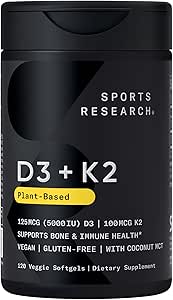 | Best D3 + K2 Combo for Bone and Heart Support | Count: 120 softgels | Vitamin D3 per softgel: 125 mcg (5,000 IU) | Vitamin K2 per softgel: 100 mcg (MK-7) | VIEW LATEST PRICE | See Our Full Breakdown |
| Deva Vegan Vitamin D3 Supplement, 1000 IU, 90 Small Tablets, 2-Pack |  | Best Starter Pick for Trying Vegan D3 | Vitamin D3 per tablet: 1000 IU | Form: Small tablets | Quantity: 90 tablets per pack | VIEW LATEST PRICE | See Our Full Breakdown |
| NatureWise Vegan Vitamin D3 5,000 IU Supplement, 60 Softgels |  | Best Certified High-Dose Pick | Vitamin D3 per softgel: 5,000 IU | Quantity: 60 softgels (2-month supply) | Source: Lichen (sustainably sourced) | VIEW LATEST PRICE | See Our Full Breakdown |
| Doctor’s Best Vegan Vitamin D3 2500 IU, 60 Veggie Capsules |  | Best Moderate-Dose Option | Form: Veggie capsules | Count: 60 capsules | Vitamin D3 per serving: 62.5 mcg (2,500 IU) | VIEW LATEST PRICE | See Our Full Breakdown |
| Sports Research Vegan Vitamin D3 + K2 with Coconut Oil, 60 Plantgels |  | Best D3+K2 Combo | Count: 60 plantgels | Serving: 1 softgel daily | Vitamin D3: 125 mcg (5,000 IU) per softgel | VIEW LATEST PRICE | See Our Full Breakdown |
| Vegan Vitamin D3 5,000 IU Supplement for Immune and Bone Health |  | Best Budget-Friendly High-Dose Pick | Vitamin D3 per serving: 5,000 IU | Source: Lichen | Dietary type: Vegan | VIEW LATEST PRICE | See Our Full Breakdown |
| vegan vitamin D3 supplement | Source | Count |
|---|---|---|
| Life Extension Vegan Vitamin D | Algae-derived cholecalciferol | 60 capsules |
| Future Kind Vegan Vitamin D3 2 | Lichen | 30 capsules |
| Naturalis Vegan Vitamin D3 + K | — | 60 softgels |
| Deva Vegan Vitamin D3 1000 IU | Lichen | — |
| Nutricost Vegan Vitamin D3 | — | — |
| Igennus Vegan Vitamin D3 1000 | Algae | — |
| Sports Research Vegan Vitamin | Lichen (VegaDelight) | 60 plant-based softgels |
| Sports Research Vegan Vitamin | — | 120 softgels |
| Deva Vegan Vitamin D3 Suppleme | Lichen | — |
| NatureWise Vegan Vitamin D3 5, | Lichen (sustainably sourced) | — |
| Doctor’s Best Vegan Vitamin D3 | Plant-sourced Vitashine D3 (lichen) | 60 capsules |
| Sports Research Vegan Vitamin | — | 60 plantgels |
| Vegan Vitamin D3 5,000 IU Supp | Lichen | — |
More Details on Our Top Picks
Life Extension Vegan Vitamin D3, 125 mcg (5,000 IU), 60 Capsules
Life Extension hits the sweet spot most vegan D3 supplements miss: a full therapeutic 5,000 IU dose from algae-derived cholecalciferol in a clean, gluten-free capsule. Compared with Future Kind’s 2,500 IU offering, this one delivers double the dose per capsule, which matters for anyone whose doctor has flagged a real deficiency rather than mild maintenance needs. The two-month supply from a single bottle also edges out the 30-day formats elsewhere in this lineup, meaning fewer reorders. The tradeoff is potency itself — 5,000 IU daily is more than some people need long-term, and this formula skips vitamin K2, unlike the Naturalis softgels, so calcium-routing support is absent. Still, for straightforward, high-dose vegan D3, this pick makes the most sense for most buyers.
Pros:- Full 5,000 IU therapeutic dose from algae-derived cholecalciferol
- Two-month supply per bottle reduces reorder frequency
- Vegan and gluten-free with no animal byproducts
- Supports bone density, cognitive function, and immune response
Cons:- 5,000 IU may be too potent for long-term unsupervised use
- No vitamin K2 for those wanting combined calcium metabolism support
Best for: Adults with diagnosed or likely vitamin D deficiency who want a high-dose, no-frills algae-based D3
Not ideal for: People who only need a maintenance dose — 5,000 IU daily may exceed requirements without medical supervision
- Serving size:1 capsule
- Vitamin D3 per capsule:125 mcg (5,000 IU)
- Source:Algae-derived cholecalciferol
- Count:60 capsules
- Supply:Two months
- Dietary features:Vegan, gluten-free
Our verdict“The most balanced high-potency choice for deficiency correction, provided you don’t need K2 paired in.”
Future Kind Vegan Vitamin D3 2500 IU, 30 Capsules
Future Kind occupies the moderate-dose middle ground between Deva’s gentle 1,000 IU tablets and Life Extension’s 5,000 IU capsules, making it a sensible stepping stone for buyers who want more than maintenance without jumping to therapeutic territory. The lichen-sourced D3 and third-party testing give it credibility that some budget options in this roundup can’t match, and the allergen exclusion list — no GMOs, gluten, soy, nuts, sugar, or artificial colors — is unusually thorough. The glass bottle also appeals to buyers cutting back on plastic. Compared with Doctor’s Best’s similar 2,500 IU veggie capsules, Future Kind’s shorter 30-count bottle means more frequent repurchasing, and the formula is D3-only, so anyone wanting K2 should look at the Naturalis or Sports Research combos instead.
Pros:- Moderate 2,500 IU dose suits long-term daily use
- Lichen-sourced vegan D3 with third-party testing
- Free from GMOs, gluten, soy, nuts, sugar, and artificial colors
- Glass bottle packaging
Cons:- Only a 30-day supply per bottle
- No K2 companion nutrient for calcium metabolism
Best for: Buyers who want a moderate 2,500 IU daily dose with third-party testing and strict allergen exclusions
Not ideal for: Anyone correcting a serious deficiency — the dose and 30-day bottle make it slow and inconvenient for that job
- Vitamin D3 per capsule:2500 IU
- Source:Lichen
- Serving:1 capsule daily
- Count:30 capsules
- Packaging:Glass bottle
- Third-party tested:Yes
- Free from:GMOs, gluten, soy, nuts, sugar, artificial colors
Our verdict“A solid once-daily middle-dose option for buyers prioritizing clean sourcing and verified testing over bottle longevity.”
Naturalis Vegan Vitamin D3 + K2 Softgels, 5000 IU D3 and 120 mcg MK-7, 60 Count
This option stands out as the only product in this batch pairing high-dose D3 with a meaningful 120 mcg of MK-7, the longer-lasting form of vitamin K2 that helps direct calcium toward bones rather than soft tissue. Where Life Extension and Nutricost offer D3 alone, Naturalis builds a more complete bone-health protocol into one softgel, with organic extra virgin olive oil improving absorption of these fat-soluble vitamins and microalgae plus biofermented natto keeping both nutrients plant-based. The two-month count matches Life Extension’s value. The tradeoffs: the oil-based softgel format must be taken with food and can cause stomach discomfort in sensitive users, and anyone on blood thinners needs medical guidance before adding K2. It’s also a more complex formula than pure D3 buyers need.
Pros:- Combines 5,000 IU D3 with 120 mcg of MK-7 K2 in one softgel
- Both nutrients from plant-based sources (microalgae and natto)
- Organic olive oil supports fat-soluble vitamin absorption
- Carrageenan-free veggie softgel made in a cGMP-certified California facility
Cons:- Oil-based softgel may cause stomach discomfort and requires taking with food
- K2 content is inappropriate for some medication regimens without doctor approval
Best for: Adults focused on bone, joint, and teeth health who want D3 and K2 working together in one vegan softgel
Not ideal for: People on anticoagulant medication or those with sensitive stomachs — the K2 and oil base both require caution
- Vitamin D3:125 mcg (5,000 IU) per softgel
- Vitamin K2:120 mcg MK-7 per softgel
- Vitamin D3 source:Nannochloropsis oceanica microalgae
- Vitamin K2 source:Biofermented natto
- Capsule:Veggie softgel, carrageenan-free
- Other ingredients:Organic extra virgin olive oil
- Suggested use:1 softgel daily with food
- Count:60 softgels
- Manufacturing:cGMP-certified facility in California
Our verdict“The clear choice for buyers who want the D3-plus-K2 synergy without abandoning vegan sourcing.”
Deva Vegan Vitamin D3 1000 IU, 90 Tablets
Deva’s 1,000 IU tablet is the gentlest entry point in this lineup, built for daily maintenance rather than deficiency correction. While Life Extension and Nutricost push 5,000 IU per serving, Deva’s modest dose aligns with what many adults actually need year-round, especially those with some sun exposure — and it avoids the oversupplementation risk that comes with high-potency capsules. The allergen exclusion list is among the strongest here, covering soy, dairy, gluten, eggs, and nuts, which makes it a safer bet for multi-allergy households than Future Kind’s formula. Compared with Igennus’s 365-tablet bulk format, the 90-count bottle suits anyone hesitant to commit to a full year of one product. The tablet form is slightly less absorbable than oil-based softgels like Naturalis’s, and it should still be taken with a meal.
Pros:- Gentle 1,000 IU dose suits everyday maintenance
- Lichen-sourced plant D3 with no animal ingredients
- Free from soy, dairy, gluten, eggs, and nuts
- 90-tablet bottle allows a trial period without bulk commitment
Cons:- Too low a dose for correcting an actual deficiency
- Tablet form lacks the fat matrix that softgels provide for absorption
Best for: Maintenance-dose seekers, vegans with multiple food allergies, and anyone wanting a low-commitment first supplement
Not ideal for: People with measured vitamin D deficiency — 1,000 IU daily is generally too low to raise levels meaningfully
- Vitamin D3 per tablet:1000 IU
- Source:Lichen
- Form:Tablets
- Quantity:90 tablets
- Dietary attributes:Vegan; non-GMO; free from soy, dairy, gluten, eggs, and nuts
Our verdict“A sensible, allergy-friendly maintenance tablet for buyers who don’t need — and shouldn’t take — high-dose D3.”
Nutricost Vegan Vitamin D3, 5,000 IU, 60 Capsules
Nutricost competes directly with Life Extension on dose and duration — 5,000 IU per capsule, 60 capsules, two months per bottle — but its distinguishing feature is manufacturing pedigree: NSF certification, GMP compliance, and an FDA-registered facility. That verification chain gives cautious buyers confidence that few budget vegan D3 products can document, and it undercuts more boutique options like Future Kind on cost-per-day logic by doubling the daily dose per bottle. The formula keeps things minimal: vegan-friendly, non-GMO, gluten-free, nothing else added. What you give up is sophistication — no K2 pairing like Naturalis offers, no algae or lichen source prominently identified the way Life Extension and Deva declare theirs, and the same high-potency caveat applies: 5,000 IU daily isn’t a forever dose for most people. This model is better suited to straightforward, verified high-dose supplementation.
Pros:- Full 5,000 IU vegan D3 per capsule at a budget-friendly per-day cost
- NSF-certified, GMP-compliant, FDA-registered manufacturing
- 60-day supply from a single bottle
- Non-GMO and gluten-free
Cons:- Plant source of the D3 is not clearly identified on labeling
- High potency is unsuitable for long-term unsupervised use
- No K2 for calcium metabolism support
Best for: Budget-conscious buyers who want a verified 5,000 IU daily dose and a full 60-day supply from one bottle
Not ideal for: Buyers who want source transparency or a combined D3+K2 formula — this is a bare-bones, high-dose option
- Vitamin D3 per serving:5,000 IU
- Capsules per bottle:60
- Supply:60 days
- Dietary features:Vegan-friendly, non-GMO, gluten-free
- Manufacturing:NSF-certified, GMP-compliant, FDA-registered facility
Our verdict“The most cost-effective way to get verified, high-dose vegan D3 — if source labeling detail doesn’t matter to you.”
Igennus Vegan Vitamin D3 1000 IU, 365 Tablets
Most vegan D3 options in this roundup push high doses, but Igennus takes the opposite approach: a modest 1000 IU per tablet in a 365-count bottle that lasts a full year. For someone with a mild deficiency or a maintenance habit already established with a doctor, this dosing makes more sense than the 5,000 IU softgels from Sports Research or NatureWise, which are designed for correcting shortfalls. The algae-sourced cholecalciferol is lab-verified and vegan-certified, and the small, odorless tablets are easier to swallow than most softgels in this guide.
The tradeoff is inflexibility: you cannot split the dose, and if your needs change, you are stuck with 365 fixed-dose tablets. Compared with the Deva 2-pack, you get far more supply per purchase but less flexibility to pause or switch.
Pros:- 365-tablet bottle covers a full year of daily use
- Algae-sourced, vegan-certified D3 with lab-verified ingredients
- Small, odorless tablets are easy to swallow
- Made in the UK under GMP standards with no unnecessary additives
Cons:- Fixed 1000 IU dose cannot be adjusted without adding a second product
- Large bottle commitment is wasteful if your dosage needs change mid-year
Best for: Buyers with confirmed adequate vitamin D levels who want a set-and-forget daily maintenance dose without reordering every couple of months
Not ideal for: Anyone correcting a diagnosed deficiency — 1000 IU per day is likely too low compared with the 5,000 IU options in this roundup
- Vitamin D3 per tablet:1000 IU
- Source:Algae
- Form:Tablets
- Quantity:365 tablets
- Supply:1 year
- Manufactured in:UK
- Certification:Vegan-certified; GMP manufactured
Our verdict“This pick makes the most sense for vegans who already know their vitamin D level is fine and simply want a year of hassle-free maintenance in one purchase.”
Sports Research Vegan Vitamin D3 5000 IU, 60 Plant-Based Softgels
This is the purest high-dose play in the lineup: 5,000 IU of lichen-sourced D3 per softgel with nothing else competing for attention. Its sibling product, the Sports Research D3 + K2 formula, adds chickpea-derived K2 — which many buyers want — but if you already take K2 separately, or your practitioner advised D3 only, this version avoids duplication. The organic virgin coconut oil base matters here too: D3 is fat-soluble, so an oil carrier supports absorption, and the formula avoids seed oils and carrageenan that some shoppers actively avoid.
Unlike Igennus, the 60-count bottle means reordering every two months, and unlike NatureWise, there is no NSF certification. The 5,000 IU dose also demands intention — this is a corrective or strongly supplemental dose, not casual maintenance.
Pros:- 5,000 IU therapeutic-strength dose from lichen in a single softgel
- Organic virgin coconut oil base supports fat-soluble absorption
- Non-GMO Project Verified and third-party tested
- Free of gluten, soy, carrageenan, and seed oils
Cons:- 60-softgel bottle only lasts two months, requiring frequent reorders
- 5,000 IU dose is too high for maintenance use without medical guidance
Best for: Adults with low sun exposure or a diagnosed deficiency who want a straightforward, well-certified 5,000 IU D3 without added nutrients
Not ideal for: People taking other high-dose vitamin D products or who have been advised a lower dose — 5,000 IU daily may be excessive for maintenance
- Serving size:1 softgel
- Vitamin D3 per softgel:125 mcg (5,000 IU)
- Source:Lichen (VegaDelight)
- Oil base:Organic virgin coconut oil
- Count:60 plant-based softgels
- Certifications:Vegan Certified; Non-GMO Project Verified
- Manufacturing:Made in the USA in a cGMP-compliant facility; third-party tested
Our verdict“A strong fit for buyers who specifically need high-dose D3 alone and value clean certifications over added companion nutrients.”
Sports Research Vegan Vitamin D3 + K2 with Coconut Oil, 120 Plantgels
Vitamin D3 improves calcium absorption, but K2 (MK-7) helps direct that calcium toward bones rather than arteries — which is why many practitioners now recommend pairing them. This Sports Research combo delivers 5,000 IU of lichen D3 plus 100 mcg of chickpea-fermented K2 in one softgel, with coconut MCT oil for absorption. Compared with the standalone Sports Research D3, this is the better choice if you take no other K2; compared with the Naturalis D3 + K2 formula, this one offers double the count at 120 softgels, stretching your supply to four months.
The tradeoffs mirror its sibling: the fixed 5,000 IU dose suits deficiency correction, not maintenance, and buyers already on blood thinners like warfarin should talk to a doctor before adding K2. It is also overkill if you only need gentle support like the Deva or Igennus tablets provide.
Pros:- Combines 5,000 IU D3 with 100 mcg of MK-7 K2 in one softgel
- Both vitamins come from fully vegan sources (lichen and fermented chickpeas)
- 120-count bottle provides a four-month supply
- Coconut MCT oil base supports absorption of fat-soluble nutrients
Cons:- K2 content makes it unsuitable for people on blood-thinning medication without medical advice
- Fixed high-dose formula offers no flexibility for lower-dose users
Best for: Buyers who want a single daily softgel that pairs high-dose D3 with K2 for bone and cardiovascular support, especially those not already taking K2
Not ideal for: People on anticoagulant medication or those needing a low maintenance dose — the K2 and 5,000 IU pairing demands medical clearance
- Count:120 softgels
- Vitamin D3 per softgel:125 mcg (5,000 IU)
- Vitamin K2 per softgel:100 mcg (MK-7)
- Vitamin D3 source:Lichen
- Vitamin K2 source:Fermented chickpeas
- Added oil:Coconut MCT oil
- Free from:Carrageenan, gluten, soy, artificial fillers
- Testing:Third-party tested; USA cGMP facility
Our verdict“The pick that makes the most sense for anyone whose doctor recommended D3 and K2 together and who wants both from vegan sources in a single capsule.”
Deva Vegan Vitamin D3 Supplement, 1000 IU, 90 Small Tablets, 2-Pack
Not everyone is ready to commit to a year-long bottle, and Deva’s 2-pack of 90 small tablets is a low-commitment way to test whether a vegan D3 routine sticks. The 1000 IU dose is gentler than the 5,000 IU NatureWise or Sports Research softgels, which makes it a reasonable starting point for buyers who have never supplemented D3 and want to gauge how they respond. The tablets are notably small and free of nearly every common allergen — yeast, wheat, gluten, soy, sugar, salt, dairy, egg, and fish are all excluded.
Compared with Igennus at the same dose, Deva offers flexibility instead of bulk: two separate bottles let you keep one at home and one at work, or simply pause between packs. The flip side is more frequent reordering and fewer certification details than the Sports Research or NatureWise options, so buyers who prioritize third-party testing may want to step up.
Pros:- Small tablets designed to be easy to swallow
- Free from yeast, wheat, gluten, soy, sugar, salt, dairy, egg, and fish
- Two 90-count packs offer flexible, low-commitment dosing
- Lichen-derived D3 suitable for vegans and vegetarians
Cons:- Requires reordering roughly every six months across both packs combined
- No third-party testing or certification details listed unlike Sports Research and NatureWise
Best for: First-time supplement users and vegans who want a gentle 1000 IU dose with allergen-free tablets and no long-term commitment
Not ideal for: Anyone correcting a deficiency or wanting certification paperwork — the dose is modest and third-party testing details are not provided
- Vitamin D3 per tablet:1000 IU
- Form:Small tablets
- Quantity:90 tablets per pack
- Pack size:2-pack
- Source:Lichen
- Suggested use:One tablet daily
- Free from:Yeast, wheat, gluten, soy, sugar, salt, dairy, egg, fish, artificial color and fragrance
Our verdict“A sensible first step for cautious buyers testing vegan D3 at a gentle dose, with the option to graduate to a higher-strength option later.”
NatureWise Vegan Vitamin D3 5,000 IU Supplement, 60 Softgels
Where this option stands out is certification rigor: NatureWise carries NSF certification on top of third-party testing, a verification layer that none of the other high-dose picks in this roundup — Sports Research included — can claim. For buyers who treat independent auditing as non-negotiable, that difference matters more than a slightly different oil base. The lichen-sourced D3 is delivered in organic extra virgin olive oil rather than coconut oil, a preference point for shoppers avoiding coconut or MCTs. The two-month supply from 60 softgels matches Sports Research’s standalone D3 exactly.
Tradeoffs are real, though: the softgels can stick together in warm weather, a storage headache the tablet-based Igennus and Deva options never face, and the 5,000 IU dose again demands that this be an intentional choice rather than a default. Buyers wanting K2 included should look at the Sports Research combo instead.
Pros:- NSF-certified and third-party tested — the strongest verification in this lineup
- Organic extra virgin olive oil base for fat-soluble absorption
- Sustainably sourced lichen D3
- Free from common allergens including dairy, soy, and peanuts
Cons:- Softgels may stick together in warm weather, complicating storage and dosing
- 60-count bottle requires reordering every two months
- 5,000 IU dose is unsuitable for maintenance without medical guidance
Best for: Deficiency-correcting buyers who prioritize NSF certification and third-party testing, and who prefer an olive oil base over coconut
Not ideal for: People in hot climates or low-dose maintenance users — softgel clumping and the 5,000 IU strength make it a poor casual choice
- Vitamin D3 per softgel:5,000 IU
- Quantity:60 softgels (2-month supply)
- Source:Lichen (sustainably sourced)
- Other ingredients:Organic extra virgin olive oil, glycerin, purified water, cassava root
- Dietary features:Vegan, non-GMO, gluten-free
- Testing and certification:NSF-certified and third-party tested
- Manufacturing:Made in the USA in a cGMP-certified facility
Our verdict“This is the pick for buyers who want the highest level of independent certification in a high-dose vegan D3 and prefer olive oil to coconut-based formulas.”
Doctor’s Best Vegan Vitamin D3 2500 IU, 60 Veggie Capsules
Between the 1,000 IU maintenance tablets and the 5,000 IU heavy hitters filling this roundup, Doctor’s Best carves out the middle ground with 2,500 IU of plant-sourced Vitashine D3 per capsule. That dose makes sense for buyers who get some sun exposure and want to top up rather than correct a deficiency, something Future Kind’s identical 2,500 IU dose also targets but in a smaller 30-capsule bottle. The veggie capsule format is a quiet advantage over softgels like the Sports Research D3+K2: no coconut oil or gelatin-style coatings to worry about, and the formula stays non-GMO, gluten-free, and soy-free. The tradeoff is dosage ceiling — anyone with diagnosed low vitamin D will likely need two capsules daily, which halves the bottle’s effective lifespan compared with single-capsule 5,000 IU options.
Pros:- Plant-sourced Vitashine D3 from a well-established, traceable supplier
- Moderate 2,500 IU dose suits maintenance rather than aggressive supplementation
- Simple capsule format free from soy, gluten, and GMOs
- Straightforward single-ingredient formula, easy to stack with separate K2 if desired
Cons:- Dose is too low for deficiency correction without taking two capsules daily
- No K2 companion, so buyers wanting calcium-routing support need a second supplement
Best for: Buyers with moderate sun exposure who want a mid-range maintenance dose in a clean capsule format
Not ideal for: People correcting a diagnosed deficiency — 2,500 IU may mean doubling up daily and burning through the 60-capsule bottle quickly
- Form:Veggie capsules
- Count:60 capsules
- Vitamin D3 per serving:62.5 mcg (2,500 IU)
- Source:Plant-sourced Vitashine D3 (lichen)
- Dietary attributes:Vegan, non-GMO, gluten-free, soy-free
- Targeted health areas:Immune health, calcium absorption, bone strength, heart function
Our verdict“A sensible middle path for anyone who finds 1,000 IU too little and 5,000 IU more than they need.”
Sports Research Vegan Vitamin D3 + K2 with Coconut Oil, 60 Plantgels
This is the most thoughtfully engineered formula in the batch: lichen D3 paired with chickpea-derived K2 (MK-7), suspended in coconut MCT oil to aid absorption of both fat-soluble vitamins. Pairing D3 with K2 matters because D3 increases calcium uptake while K2 helps direct that calcium toward bones rather than arteries — a synergy Naturalis’s D3+K2 softgels also chase, though Sports Research distinguishes itself with Vegan Certification, Non-GMO Project Verification, and third-party testing, a paper trail few competitors here can match. The once-daily plantgel is genuinely convenient. The catch is potency: at 5,000 IU per softgel, this matches the ceiling of standalone options like Nutricost’s D3, so anyone used to gentler doses from Deva’s 1,000 IU tablets should not jump straight in. Coconut oil, while functional, is also an allergen flag for a small group of buyers.
Pros:- Combines lichen D3 with chickpea-derived K2 (MK-7) for directed calcium support
- Coconut MCT oil improves absorption of the fat-soluble vitamins
- Vegan Certified, Non-GMO Project Verified, and third-party tested
- Once-daily plantgel free from carrageenan, gluten, soy, and artificial fillers
Cons:- Fixed 5,000 IU dose is more than many maintenance users need
- Contains coconut-derived MCT oil, a problem for those with coconut sensitivities
Best for: Buyers who want D3 and K2 in one certified, third-party-tested daily softgel for bone and cardiovascular support
Not ideal for: Coconut-sensitive buyers and anyone wanting a low or adjustable dose — each softgel delivers a fixed 5,000 IU
- Count:60 plantgels
- Serving:1 softgel daily
- Vitamin D3:125 mcg (5,000 IU) per softgel
- Vitamin K2:100 mcg (MK-7) per softgel
- Vitamin D3 source:Lichen
- Vitamin K2 source:Fermented chickpeas
- Added oil:Coconut MCT oil
- Certifications:Vegan Certified; Non-GMO Project Verified
- Testing and manufacturing:Third-party tested; made in USA in cGMP facility
Our verdict“The most complete all-in-one choice for buyers who take bone and heart health seriously and want the certifications to back it up.”
Vegan Vitamin D3 5,000 IU Supplement for Immune and Bone Health
For buyers whose priority is simply getting a therapeutic 5,000 IU of lichen-based D3 at a low cost per serving, this no-frills option does the job without extras. Where Sports Research layers in K2, MCT oil, and certifications, and Doctor’s Best offers the Vitashine pedigree at a gentler dose, this supplement strips everything back to the essentials — which is exactly its appeal for budget-conscious or high-need users. The 5,000 IU strength matches Life Extension and Nutricost’s vegan D3 offerings and suits those with limited sun exposure or higher requirements. The flip side of that minimalism is thin documentation: serving size and full ingredient details are sparse, with no third-party testing claims to point to. Buyers who value verified sourcing will prefer the Sports Research or Life Extension routes; those who just want lichen D3 at strength will find the simplicity acceptable.
Pros:- Full 5,000 IU dose from lichen, suitable for those with limited sun exposure
- Broad claimed support spanning immunity, bones, mood, and calcium absorption
- Simple single-focus formula keeps things uncomplicated and stackable
Cons:- Serving size and complete ingredient information are not clearly provided
- No third-party testing or certification claims to verify quality
- No K2 pairing, unlike comparably priced combo formulas
Best for: Budget-minded buyers who need a high 5,000 IU lichen D3 dose and don’t require bundled extras
Not ideal for: Detail-driven shoppers who want full ingredient transparency and third-party testing documentation
- Vitamin D3 per serving:5,000 IU
- Source:Lichen
- Dietary type:Vegan
- Targeted health areas:Immune health, calcium absorption, bones, mood, cognitive function
- Dose class:High-dose (5,000 IU) therapeutic range
Our verdict“A straightforward high-dose lichen D3 for buyers who prioritize strength and simplicity over transparency and extras.”
How We Picked
I evaluated each product through the lens a vegan buyer actually cares about: first, verified plant-based D3 sourcing (lichen, with certification where available), then dose strategy — whether the product suits maintenance (1,000–2,500 IU) or deficiency correction (5,000 IU). From there I compared delivery format and absorption support, favoring softgels with a fat carrier over dry tablets for bioavailability, and giving weight to formulas that add K2 at meaningful MK-7 doses. Finally, I assessed cost per day over the full bottle, since a cheap-looking 30-count bottle often costs more per month than a larger one.
The ranking logic is straightforward: products that combine sensible dosing, absorption support, and strong per-serving value sit at the top; single-purpose products fill specific niches like beginner doses or travel-friendly formats. Where two products offered nearly identical potency — common in the crowded 5,000 IU tier — I separated them by format, K2 inclusion, and bottle economics rather than rehashing the same dose.
| vegan vitamin D3 supplement | Source |
|---|---|
| Life Extension Vegan Vitamin D | Algae-derived cholecalciferol |
| Future Kind Vegan Vitamin D3 2 | Lichen |
| Naturalis Vegan Vitamin D3 + K | — |
| Deva Vegan Vitamin D3 1000 IU | Lichen |
| Nutricost Vegan Vitamin D3 | — |
| Igennus Vegan Vitamin D3 1000 | Algae |
| Sports Research Vegan Vitamin | Lichen (VegaDelight) |
| Sports Research Vegan Vitamin | — |
| Deva Vegan Vitamin D3 Suppleme | Lichen |
| NatureWise Vegan Vitamin D3 5, | Lichen (sustainably sourced) |
| Doctor’s Best Vegan Vitamin D3 | Plant-sourced Vitashine D3 (lichen) |
| Sports Research Vegan Vitamin | — |
| Vegan Vitamin D3 5,000 IU Supp | Lichen |
Factors to Consider When Choosing Vegan Vitamin D3 Supplements
Before picking a specific bottle, it helps to understand what actually separates a smart vegan D3 purchase from a wasted one. These are the factors that shaped my rankings — and the mistakes I see buyers make most often.Lichen Sourcing and Vegan Verification
The single most common mistake is assuming all vitamin D3 labeled “natural” is vegan — the default industrial source is lanolin from sheep’s wool, and labels often bury this. True vegan D3 comes from lichen, a symbiosis of algae and fungi, and reputable brands state this explicitly or carry Vegan Society, Vegan Action, or similar certification. Uncertified products aren’t automatically suspect, but you should expect transparent sourcing language before trusting the claim. Watch also for hidden non-vegan ingredients in the capsule itself: some softgels use gelatin shells rather than plant-based alternatives like the “Plantgels” or carrageenan-based capsules used by several picks here. If a product doesn’t clarify its shell material, that’s a reasonable disqualifier for strict vegans.
Matching the Dose to Your Actual Needs
This lineup spans 1,000 to 5,000 IU, and choosing wrong in either direction wastes money. 1,000–2,500 IU suits daily maintenance for people with reasonable sun exposure and normal baseline levels, while 5,000 IU is a correction-level dose better suited to winter months, higher latitudes, darker skin tones, or a confirmed deficiency. Taking 5,000 IU year-round without ever testing your blood level is a common and avoidable mistake — a simple 25(OH)D test costs little and tells you which tier you belong in. Also note that more isn’t linearly better: very high sustained intake without medical supervision can push calcium levels too high. If you’re unsure, starting at a moderate dose and testing after three months beats guessing.
Why K2 Pairing Matters at Higher Doses
Vitamin D3 increases calcium absorption, but K2 (specifically the MK-7 form) activates proteins that direct that calcium into bones and teeth rather than arteries and soft tissue. At maintenance doses of 1,000 IU, this matters less; at 5,000 IU, a K2 pairing is a sensible safeguard, which is why the combined D3+K2 products rank highly here. Check the form and dose: MK-7 at 100–120 mcg is the well-studied sweet spot, while MK-4 requires much larger amounts and is less common in vegan formulas. One tradeoff to know — combination products cost more per capsule and lock you into a fixed ratio. If you already take K2 separately or eat natto regularly, a standalone D3 is the smarter buy.
Softgels vs. Tablets: Absorption and Practicality
Vitamin D is fat-soluble, meaning it absorbs best alongside dietary fat. Oil-based softgels build that fat into the dose — coconut and MCT oil carriers are the common vegan choices — so you can take them on an empty stomach without much loss. Dry tablets and veggie capsules are cheaper and more stable, but ideally should be taken with a meal containing fat to absorb properly; with a black coffee alone, you may absorb far less than the label suggests. Tablets win on other fronts: they’re typically smaller, easier to split for dose-tuning, and better for travel or office drawers. Your routine should drive this choice more than marketing does.
Cost Per Day, Not Price Per Bottle
A 60-count bottle of 5,000 IU capsules is a two-month supply; a 90-count bottle of 1,000 IU tablets at the same price is three months at a quarter of the potency — the math changes completely once you calculate cost per 1,000 IU per day. Large bottles like the Igennus 365-tablet format and multi-packs reward commitment, but only buy in bulk once you’ve confirmed a product agrees with you. Also factor in flexibility: if your dose needs may change after a blood test, a smaller bottle avoids waste. Subscription discounts can help, but only if the dose and format are already right for you.
Third-Party Testing and Brand Transparency
Vitamin D is one of the most poorly regulated supplement categories when it comes to actual potency versus label claims — independent analyses regularly find products delivering far more or less than stated. Look for brands that publish third-party testing (USP, NSF, or IFOS-style certificates of analysis), or at minimum state their testing practices openly. This matters more at 5,000 IU, where a 40% overage compounds quickly with daily use. Lichen-derived D3 also varies in isomer purity between suppliers, so a brand that names its supplier or publishes purity data deserves more trust than one that doesn’t. It’s the least glamorous factor here, but arguably the most consequential.
Frequently Asked Questions
Is lichen-derived D3 as effective as lanolin-based D3?
Yes — chemically, lichen-derived D3 is identical cholecalciferol, the same molecule your skin produces from sunlight and the same compound extracted from lanolin. Studies comparing the two sources have found comparable rises in blood 25(OH)D levels at matched doses. What matters more than the source is the dose, the delivery format, and whether you take it with fat. An oil-based softgel from lichen can outperform a dry lanolin-based tablet purely on absorption grounds. So if you’ve delayed switching to a vegan D3 over efficacy concerns, that hesitation isn’t supported by the evidence.
Should I choose 1,000 IU or 5,000 IU if I don’t know my blood level?
If you’ve never tested, a middle path of 2,000–2,500 IU is the safest default, which is exactly why options like Future Kind and Doctor’s Best exist in this lineup. Jumping straight to 5,000 IU daily is reasonable in winter or if you have risk factors for deficiency (limited sun, darker skin, living far from the equator), but it’s a correction-level dose that deserves a follow-up blood test after about three months. Staying at 1,000 IU when you’re actually deficient just delays fixing the problem. The practical answer: pick a mid-tier dose now, test, then move up or down based on real numbers rather than guesswork.
Do I really need K2 with my vegan D3, or is that upselling?
It’s not pure upselling, but it’s also not mandatory for everyone. K2’s role — activating matrix GLA protein to keep calcium out of arteries — becomes more relevant as your D3 dose and calcium intake climb, so at 5,000 IU daily the pairing is a reasonable precaution. At 1,000–2,000 IU with a normal diet, the benefit is smaller and a standalone D3 is perfectly defensible. The main argument against combos is flexibility: fixed D3+K2 ratios cost more and prevent you from adjusting one vitamin without the other. If you eat fermented foods like natto or sauerkraut regularly, you’re already getting K2 and can skip the combo.
Are vegan softgels as stable and easy to swallow as gelatin ones?
Plant-based softgel shells (usually carrageenan, modified starch, or the “Plantgel” blends used by Sports Research) have closed most of the gap with gelatin, though they can be slightly firmer and a little more prone to sticking together in humid conditions — store them cool and dry with the desiccant if included. Swallowing is generally comparable, and several vegan softgels in this lineup are actually smaller than their gelatin equivalents because the oil carrier is concentrated. Tablets remain the most stable format of all, which is why the Igennus 365-count bottle can survive a year of daily opening. If you live somewhere hot and humid, that stability difference is worth weighing against the absorption advantage of oil-based softgels.
Can I get enough vitamin D as a vegan without any supplement at all?
In theory yes, in practice rarely. Vitamin D3 isn’t found in meaningful amounts in any common plant food — UV-exposed mushrooms provide D2, a less effective form that raises blood levels less efficiently and clears faster. Sunlight remains the only reliable vegan source, but latitude, season, sunscreen, skin tone, indoor lifestyles, and age all cut synthesis dramatically; most people living above roughly 37° latitude make little to none from October through March. This is why vitamin D is one of the few supplements nearly universally recommended for vegans, alongside B12. Think of a lichen-derived D3 not as compensating for a plant-based diet, but as covering a gap that affects most of the population regardless of how they eat.
Conclusion
If you want the short version: the Naturalis D3 + K2 Softgels is my best overall pick, combining a correction-level dose with MK-7 and an oil base in one capsule. For best value, the Igennus 365-tablet bottle is nearly impossible to beat on cost per day, with the Deva 2-pack close behind for small, easy-to-swallow maintenance dosing. On the premium side, the Sports Research D3 + K2 with Coconut Oil, 120-count justifies its higher price with a well-executed absorption formula and a long supply. Beginners who want a low-commitment starting point should look at Future Kind 2,500 IU or Doctor’s Best 2,500 IU — enough potency to matter without overshooting an untested baseline. For specific needs: choose Nutricost or Life Extension for straightforward high-dose standalone D3, Deva 1,000 IU tablets for the smallest, gentlest format, and the Sports Research 60-count D3+K2 if you want the combo formula at a lower commitment. Whichever you choose, pair it with a blood test after a few months — the number on your lab report, not the label, is what confirms you picked right.
Cold & flu season Picks
humidifiers
As an affiliate, we earn on qualifying purchases.