
TL;DR

Get health and wellness essentials delivered free with Prime
- Fast, free delivery on millions of items
- Prime Video, Amazon Music and more included
- Member-only deals all year
A Being Patient report connects research on visceral fat and high blood pressure with evidence linking untreated hypertension to Alzheimer’s risk. The findings do not show that a DEXA scan can predict an individual’s brain health; the report points instead to blood pressure as a practical health measure to monitor.
A Being Patient report has connected research on deep abdominal fat with evidence that untreated high blood pressure is associated with a higher chance of developing Alzheimer’s disease. The research does not establish that a person’s visceral-fat level predicts their brain health, and the report’s author says her DEXA result should not be treated as a dementia test.
Being Patient founder Deborah Kan described paying about $50 for a DEXA scan, which estimated that she had 0.41 pounds of visceral fat. She said the scan took about seven minutes and supplied a comparison with 27,000 people in her age group. Those figures describe her personal result; they do not establish a clinical threshold for brain health or show that her running caused the result.
The report distinguishes a DEXA scan, which estimates visceral-fat quantity, from an MRI, which can show where fat is located. It then cites a seven-year study of 903 Dallas residents who began with normal blood pressure. About one-quarter developed hypertension. Body weight was associated with who developed high blood pressure, but after the researchers accounted for fat distribution, visceral fat was the only type of fat that remained associated, according to the report’s summary of the study.
The report also cites a 2024 study of more than 31,000 older adults across 14 countries. Untreated high blood pressure was associated with a 42% higher chance of developing Alzheimer’s, while that additional risk was not found among people whose blood pressure was controlled, the report says. This is an association reported by the study, not proof that blood pressure alone causes Alzheimer’s or that lowering it prevents every case.
Why Blood Pressure Enters the Picture
The connection matters because visceral fat and hypertension may help identify cardiovascular risks relevant to the brain. High blood pressure can damage blood vessels, including those that supply the brain. The report’s focus is therefore less on whether a scan can reveal a person’s future cognitive health and more on the possible chain between fat distribution, blood pressure and vascular health.
That distinction can help readers avoid overreading a body-composition result. A low estimate of visceral fat is not a guarantee of good brain health, and a higher estimate is not a diagnosis of cognitive decline. The cited studies describe group-level relationships; they do not offer a personal forecast from a single scan. The report presents routine blood-pressure checks as a more actionable measure, while noting that hypertension often has no obvious symptoms.
Dr. Nate Chin, a geriatrician and medical director of the Wisconsin Alzheimer’s Disease Research Center, told Kan that blood pressure is the best window available into brain health. He recommended checking it several times a week and keeping it in the normal range, which he described as below 120/80. That is his guidance as quoted in the report, not an individualized assessment for every reader.
As an affiliate, we earn on qualifying purchases.
From Fat Distribution to Hypertension
The Dallas research followed participants for seven years and used imaging to assess where fat was carried, rather than relying only on body weight. The report says the findings singled out visceral fat as the fat distribution measure still associated with later hypertension after accounting for other factors described in its summary. It also notes that other studies have examined fat around the kidneys and blood pressure, but says more research is needed to understand that relationship.
The report connects this work to wider research on vascular health and dementia. Its cited international study concerned older adults in 14 countries and compared Alzheimer’s risk in relation to untreated versus controlled high blood pressure. These findings add to discussion of potentially modifiable risk factors, but the report does not claim that abdominal fat itself has been shown to cause Alzheimer’s disease.
Kan’s own scan was a personal starting point, not a research finding. She acknowledged that people who pay for body scans may be more health-conscious than the broader population, which could affect the comparison group behind her report. Her estimate and peer ranking should not be generalized to everyone.
“Zero visceral fat seems ambitious and unnecessary at my lower levels.”
— Deborah Kan, Being Patient founder
As an affiliate, we earn on qualifying purchases.
What a Fat Scan Cannot Show
The cited evidence does not show that a DEXA scan can determine whether someone will develop Alzheimer’s or measure their current brain health. Kan’s result is a personal estimate, and the report does not establish what visceral-fat level would meaningfully change an individual’s dementia risk. It also does not say whether running caused her relatively low result.
The report summarizes associations rather than proving a direct causal chain from visceral fat to high blood pressure to Alzheimer’s. The detailed methods and limitations of the cited studies are not included in the supplied material, so the size and limits of those associations cannot be independently assessed here. The report also says the relationship between fat around the kidneys and hypertension needs further study.
It remains unclear whether measuring visceral fat adds useful predictive information beyond established health measures for an individual patient. A scan’s comparison group may not represent the general population, and a single blood-pressure reading or body scan cannot by itself provide a full health assessment.
As an affiliate, we earn on qualifying purchases.
Practical Checks and Further Research
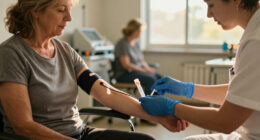
The report’s immediate takeaway is to pay attention to blood pressure, which can be elevated without symptoms. Chin suggested using a home cuff and checking several times weekly. Readers concerned about their readings or the significance of a body-composition result should discuss them with a qualified health professional, who can interpret measurements in light of their health history.
Further research will be needed to clarify how visceral fat relates to hypertension, whether fat in particular locations has distinct effects, and how those factors fit into dementia risk. The cited studies do not establish that reducing visceral fat prevents Alzheimer’s. For now, the report frames a DEXA scan as one possible source of body-composition information, not a brain-health test, and points to blood-pressure monitoring as the more practical measure it highlights.
As an affiliate, we earn on qualifying purchases.
Key Questions
Can a DEXA scan tell me whether I will develop Alzheimer’s?
No evidence in this report supports that use. A DEXA scan estimates visceral-fat quantity; the report does not present it as a way to diagnose or predict Alzheimer’s disease.
What did the Dallas study find?
The report says researchers followed 903 people for seven years, and about one-quarter developed high blood pressure. After accounting for fat distribution, visceral fat was the type still associated with hypertension in the study summary.
Does high blood pressure cause Alzheimer’s?
The cited 2024 study found an association: untreated high blood pressure was linked to a 42% higher chance of Alzheimer’s among the older adults studied. The report does not establish that hypertension alone causes the disease.
What does the report suggest monitoring?
Dr. Nate Chin recommended checking blood pressure several times a week and keeping it below 120/80, as quoted by Kan. People should seek qualified professional guidance for advice specific to their circumstances.
Source: rss
Halloween Picks
halloween
As an affiliate, we earn on qualifying purchases.