

TL;DR

Get health and wellness essentials delivered free with Prime
- Fast, free delivery on millions of items
- Prime Video, Amazon Music and more included
- Member-only deals all year
A study tracking 316,542 Korean adults found that people in the lowest fifth of hemoglobin levels had a 16% higher risk of dementia than the study’s reference group. Some higher-risk associations also appeared among people with the highest levels, particularly for vascular dementia, but the observational findings do not show that hemoglobin causes dementia.
A study of 316,542 adults in South Korea found that hemoglobin levels recorded during routine health screenings were associated with dementia diagnoses over as long as 15 years of follow-up. The findings, presented at the 39th ECNP Congress and published in the Journal of Alzheimer’s Disease, suggest a possible long-term risk marker, but do not show that hemoglobin levels cause dementia or that changing them would prevent it.
The researchers used national health screening data from 2004 and 2005 for adults aged 40 and older, then checked national health insurance records for new dementia diagnoses through the end of 2019. They divided participants into five groups according to their hemoglobin levels, from the lowest fifth to the highest fifth. Hemoglobin is a protein in red blood cells that carries oxygen around the body.
Compared with the group used as the reference because it had the lowest dementia rate, participants in the lowest hemoglobin fifth had a 16% higher risk of all-cause dementia. Those in the highest fifth had a 7% higher risk. The pattern varied by diagnosis: for Alzheimer’s disease, the reported increase was concentrated in the lowest fifth, at 14% above the reference group. For vascular dementia, the lowest fifth had a 19% higher risk and the highest fifth an 18% higher risk. The vascular dementia association did not follow a simple pattern across all five groups.
The researchers also reported that associations were clearer and more consistent in women than in men. The report does not establish why the results differed by sex, and the findings do not indicate that an individual with an unusually high or low result will develop dementia.
What Routine Hemoglobin Results May Signal
Hemoglobin is already measured in many routine blood tests, making it an accessible measure to study across large populations. If further research confirms the association, such results could help researchers examine how whole-body health and brain health relate over time. The study does not establish that hemoglobin screening can predict dementia accurately for an individual, or that it should be used as a standalone dementia risk test.
Lead researcher Dr. Hyun Soo Kim, an assistant professor at Dong-A University College of Medicine in Busan, said the findings may indicate that abnormal hemoglobin levels are a visible marker of broader physical vulnerability relevant to brain health. He said simple markers could help researchers and clinicians better understand links between physical health and later dementia, for which treatments remain limited and there is no cure.
The practical message is not to try to change hemoglobin levels to affect dementia risk. Low levels are commonly associated with anemia, while high readings can be associated with factors including smoking, dehydration, lung or heart disease, and other medical conditions. Any abnormal result should be discussed with a doctor to assess its cause, rather than treated as a dementia forecast.
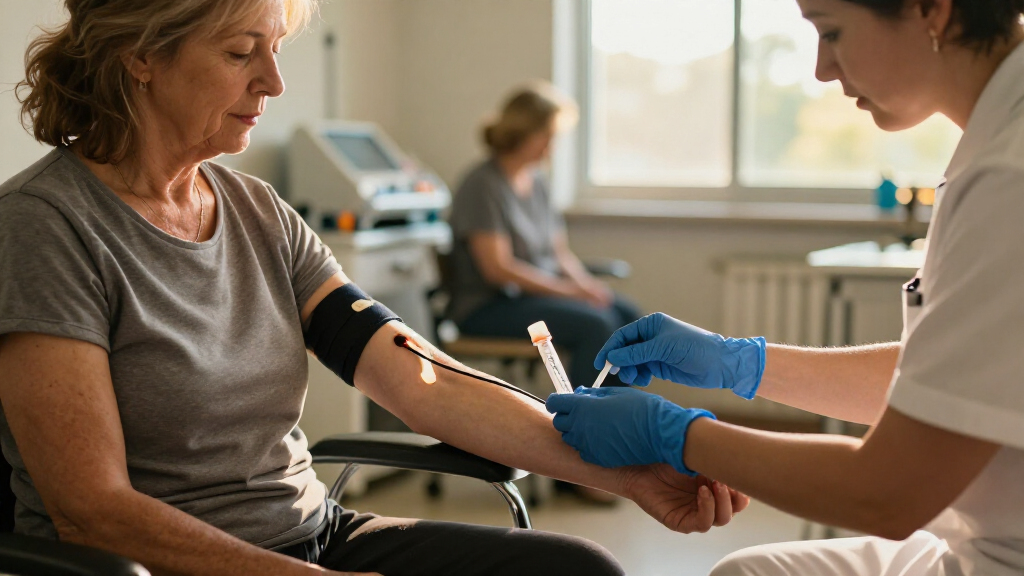
routine blood test hemoglobin levels
As an affiliate, we earn on qualifying purchases.
As an affiliate, we earn on qualifying purchases.
How the Korean Cohort Was Tracked
The study drew on health screening records for 316,542 Korean adults aged 40 and over. Their screening took place in 2004–2005, and researchers used national insurance records to identify new dementia diagnoses through 2019. This design allowed the team to compare an earlier blood measurement with diagnoses recorded over a period of up to 15 years.
Because the study was observational, it can identify patterns but cannot establish what caused them. Other health conditions or circumstances may be connected both to hemoglobin levels and to dementia risk. The researchers also noted that early, undiagnosed dementia processes might affect nutrition, frailty, weight loss or anemia, which could help explain some of the association.
Dr. Lindsey Sinclair of the University of Southampton, commenting on the findings, said evidence is growing that physical and brain health are interconnected. She said more work is needed to determine whether the link applies across people from a wider range of backgrounds and what measures, if any, could reduce dementia risk among those with the lowest or highest hemoglobin levels.
As an affiliate, we earn on qualifying purchases.
Limits of the Risk Association
The findings do not prove that low or high hemoglobin directly increases dementia risk. Since the study tracked an association rather than testing an intervention, it cannot show whether changing hemoglobin would alter the chance of developing dementia. Reverse causation is also possible: early dementia may affect health or nutrition before a diagnosis is recorded.
The results came from a Korean cohort, and it remains unclear whether the same patterns would appear in populations with different backgrounds. The report does not establish an individual-level prediction method, explain the stronger pattern reported in women, or identify a hemoglobin range that could be used to prevent dementia. It also does not show that a routine blood test can diagnose dementia.
As an affiliate, we earn on qualifying purchases.
Research Needed Beyond Korea
Further studies will need to test whether the association appears in groups with a wider range of backgrounds and clarify how other health conditions, nutrition and early dementia processes may affect the results. Researchers will also need to determine whether hemoglobin adds useful information to existing approaches to studying dementia risk.
For now, the findings are a research lead rather than a change to clinical guidance. Kim advised people not to use the study as a reason to take iron supplements or deliberately raise or lower hemoglobin. People with an abnormal blood-test result should discuss it with a qualified health professional, who can assess possible underlying causes.
As an affiliate, we earn on qualifying purchases.
Key Questions
What did the study find about hemoglobin and dementia?
In a study of 316,542 Korean adults, the lowest fifth of hemoglobin levels was associated with a 16% higher risk of all-cause dementia than the study’s reference group. Some associations were also reported for the highest fifth, including for vascular dementia. These are group-level associations, not predictions for a particular person.
Does low hemoglobin cause dementia?
The study does not show that low hemoglobin causes dementia. It was observational, meaning researchers tracked an association rather than testing whether changing hemoglobin affects dementia risk. The researchers also said early dementia could affect factors such as nutrition or frailty.
Should someone take iron supplements to reduce dementia risk?
No. The study does not support taking iron or changing hemoglobin levels to prevent dementia. Anyone concerned about a blood-test result should discuss it with a qualified health professional rather than self-treating.
Who took part in the study, and how long were they followed?
The study included 316,542 South Korean adults aged 40 and older who had national health screenings in 2004–2005. Researchers checked insurance records for new dementia diagnoses through the end of 2019, allowing up to 15 years of follow-up.
Can a routine blood test diagnose dementia?
No. The findings describe an association between hemoglobin levels and later diagnoses in a population. They do not establish that hemoglobin can diagnose dementia or reliably predict whether an individual will develop it.
Source: rss
Columbus Day / Indigenous Peoples' Day Picks
long weekend sales
As an affiliate, we earn on qualifying purchases.